
By Zhang Beimei, Xu Zirui, Chen Fangdi, Zhao Luzhe
Michael Levitt, the 2013 Nobel Prize winner, who has attended the World Laureates Association (WLA) Forum for seven years in a row, quickly conveyed his attention on this year’s forum while sitting on the sofa, wearing a pair of red-rimmed glasses and having gray hair.
“I think the focus as always is international scientific exchange. We’ve emphasized young people from the very beginning, and I think also it’s very multidisciplinary,” Levitt said.
Levitt leads a slash career in scientific research. He started his studies in South Africa, advancing in the UK, teaching in the US, and once working at research institutions in Israel. His expertise spans applied mathematics, physics, biology, computer science, and more.Being an elder in the scientific community, Levitt believes in boundary-free disciplines and enjoys exchanging ideas with young people. As a fan of Chinese scientific fiction The Three-Body Problem, he admires China’s achievements across various fields.
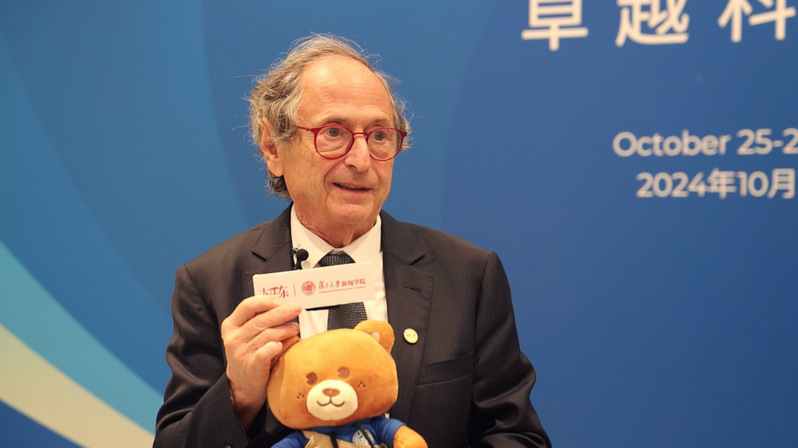
Levitt is interviewed by People’s Daily at 2024 WLA Forum. (Photo: provided to People’s Daily)
Serendipity Sparks Inspiration
Imagine a yarn representing a protein’s amino acid chain, twisting and knotting to form a sweater. Similarly, proteins must fold correctly to function properly. Studying protein folding helps scientists understand disease mechanisms and advance biotechnology.
Levitt was one of the first to perform molecular dynamics simulations of DNA and proteins, developing the pioneering software for the studies. Levitt received the Nobel Prize in Chemistry with Martin Karplus and Arieh Warshel for creating multiscale models of complex chemical systems in 2013.
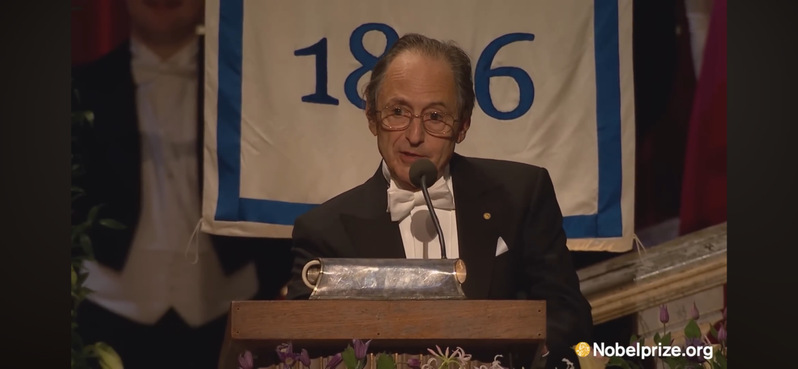
Levitt delivers a speech at the Nobel Prize banquet. (Photo: Nobel Prize.org)
Sixty years ago, 17-year-old Levitt came across a science TV program, The Thread of Life, hosted by John Kendrew, the 1962 Nobel laureate in Chemistry. This program showed how proteins folded into their shape. “I think I was very fascinated by proteins because proteins have shape and the protein shape is what gives our body shape,” Levitt recalled.
After completing his undergraduate studies in physics at King’s college, Levitt reached out to Kendrew, then co-head of structural research at the MRC Laboratory of Molecular Biology in Cambridge, seeking to become his student. His initial request was declined, but after a second attempt, Kendrew advised him to wait a year for a final decision.
Levitt drove to Cambridge, where he crossed paths with Max Perutz, the lab’s other co-head. Perutz invited him into his office for a discussion and ultimately told him to expect a response by the following Monday.
Kendrew responded on Monday and suggested Levitt go to Israel’s Weizmann Institute and then return to Cambridge in a year. It was in Israel that Levitt met Arieh Warshel, and together they developed computer programs.
“Many interesting things happen by chance,” Levitt said. Yet, he sees the Nobel title as not just an honor but a responsibility to inspire young people to appreciate science, saying, “Science is driven by young people.”
Levitt once visited Shanghai University, where he met Francesco Zonta, now a biological professor at Xi’an Jiaotong-Liverpool University. He offered Zonta suggestions on protein design and antibody design. Zonta spoke warmly of Levitt, saying, “He is one of the smartest people I’ve met and is a very very nice person.”
Trying Asking AI
A white tablecloth filled with the content of a discussion was brought onto the stage when Levitt’s group presented their report at the Tablecloth Workshop of the Sci-T Conference, a WLA Forum session for middle school students.
The group presenters were randomly selected by ChatGPT from a pool of 1-10. The presenter, Liu Zimo, who was chosen as No. 5, shared their group’s viewpoints on the stage, saying, “We believe that randomness also signifies equality, diversity, and openness, which is the message we want to convey.”
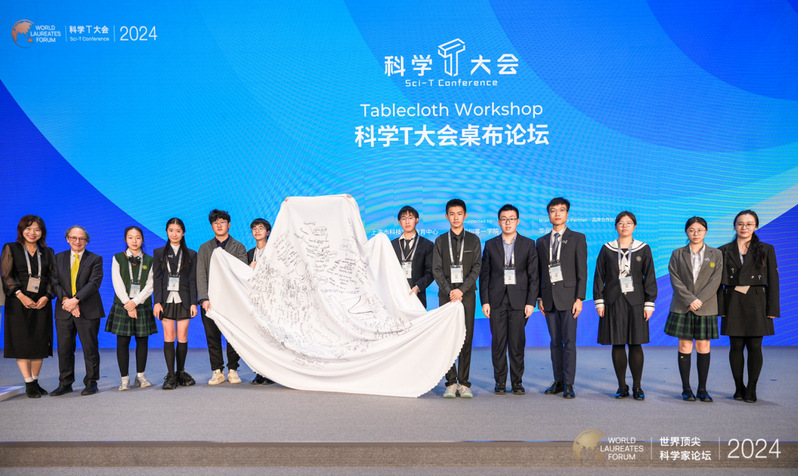
Levitt and panel members at the Tablecloth Workshop of the Sci-T Conference. (Photo: WLA)
Levitt also encouraged young people to abandon existing prejudices and embrace more possibilities. He mentioned that his wife often says he is as curious as a 7-year-old. “Be as curious as you can. Ask questions, especially with AI,” Levitt said. He loves to communicate with AI about emotional or knowledge-related questions, such as “What can I do to be happy” or “Tell me about this Chinese painting.”
As artificial intelligence continues to transform industries worldwide, Fudan University has launched an AI curriculum system and reformed its education model since this fall semester. It will introduce at least 100 artificial intelligence courses in the 2024-25 academic year.
Levitt, Honorary Dean of Multi-scale Research Institute for Complex Systems at Fudan University, was deeply impressed, saying, “We are supposed to have a class where students are told just go and do something clever with AI …… I think we need to start learning from our students.”
Levitt encourages interdisciplinary communication and collaboration as well, encouraging young people to generate inspiration from different ideas and create more new ideas. “When people from different disciplines communicate, interesting things happen,” Levitt said.
Going Against the Direction
“We want young people to like science, the same way that they might like TikTok or music or tennis players or something like that,” said Levitt.
Levitt often interacts with the younger generation. He has attracted 450,000 followers, sharing experiences and engaging with young netizens through videos on Bilibili, a video-sharing website often called Chinese YouTube. At the same time, he teaches an undergraduate course titled Introduction to Frontiers in Quantitative Biophysics at Fudan University.
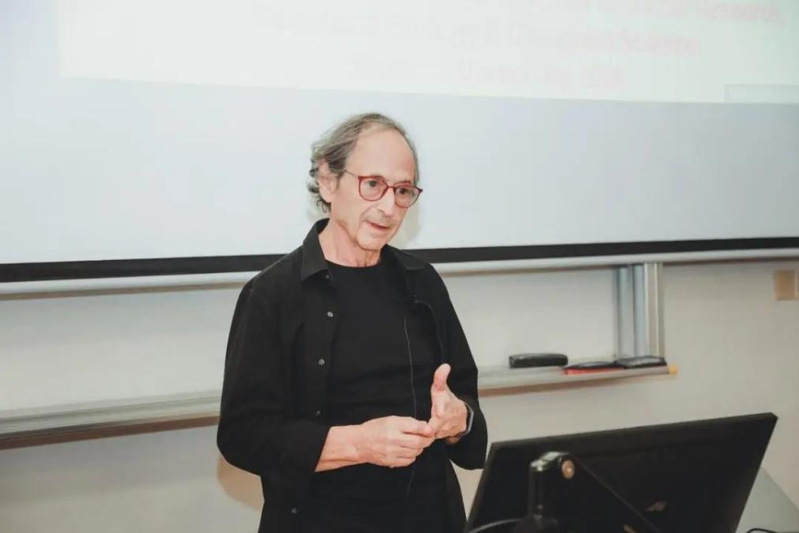
Levitt is teaching the course Introduction to Frontiers in Quantitative Biophysics at Fudan University.(Photo: Multi-scale Research Institute for Complex Systems at Fudan University.
Levitt emphasized that young people should embrace their mistakes. He said if a world champion in high jump chooses to jump over a low bar, he will never make a mistake and can jump perfectly over it, but there is no challenge in that. “He never misses. He makes it perfectly, but it’s not exciting,” Levitt noted.
“I think for creativity you have to believe in yourself and sometimes go against the direction,” Levitt said, “I think in China there’s quite a lot of originality and enthusiasm for new directions.”
“WeChat may not win a Nobel Prize, but it deserves some recognition,” he said, pointing to the QR code on a badge as WeChat has helped the use of QR codes in China. Although QR codes were invented in Japan, it’s China that promoted them. “What we really care is enabling people, instead of saying, ‘no, it’s my QR code. I won’t let you have it’.” he added.
As a fan of science fiction, Levitt highlighted that China has also demonstrated remarkable creativity in artistic expression. The Three-Body Problem, a Chinese science fiction also praised by Obama, Zuckerberg, and Bill Gates, impressed him. Levitt was amazed at the fiction’s intricate plot and imaginative concepts.
“I think we have many very important abilities in China and creations and achievements,” Levitt remarked.